

Trauma-Informed Decision Making: Why the Best Leaders Don't Just Decide Fast—They Decide Well

We make 35,000 decisions a day. If we're lucky, maybe 10 are conscious. If we're not careful, none of them are trauma-informed.
And every single one is teaching your team who you are.
When Crisis Hits, Most Leaders Speed Up. One Acre Fund Slowed Down.
When crisis strikes, most organizations demand productivity through the chaos.
But One Acre Fund’s leadership did the opposite: they paused the work.
For nearly two decades, Once Acre Fund has worked alongside smallholder farmers across Africa, creating pathways to prosperity by helping communities grow more food, increase income, and build resilience.
When crisis hit their region, One Acre Fund’s relocated staff to where they felt safe. They kept their people employed for a year and a half—even when they couldn't do the work—and even adjusted salaries to support their folks as cost of living increased. They built welfare trackers and adjusted success metrics to meet reality instead of forcing reality to meet metrics.
In Swahili, it turns out, “resilience” isn’t understood as a personal attribute the way it is in English. Instead, it is expressed as a collective action.
Resilience isn’t something you are; it’s something we do, together.
One Acre Fund's leadership understood what most leaders miss: Decisions aren't simple transactions, they're interventions.
Decisions are not merely operational, workflow management tasks. Decisions shape the field; they signal values and safety; they teach people and systems how to be.
The Cost of Speed
We’ve been taught that good leadership means being decisive, moving quickly, exuding confidence, and controlling the outcome. Stoic, sure, and stable.
And yes, they matter: Stability and consistency help teams maintain a sense of safety. However decisions made from urgency, certainty, and control create harm, even when intentions are good. Decisions that happen too fast, drag on too long, lack transparency, or isolate people from the process don't just cause stress—they create traumatic stress conditions. Not because the decision itself is inherently wrong, but because the way it's made signals: your perspective doesn't matter, your safety isn't our concern, your voice doesn't count.
What looks like efficiency becomes an erosion of psychological safety; teams lose trust not because leaders chose poorly, but because how they chose told people they weren't worth including.
Traditional decision-making asks: What should we choose?
Trauma-informed decision-making also asks: What's happening beneath the choice, and what’s the impact of how we make it?
Decisions Are Where Culture is Formed
Every decision is a microcosm of your culture.
The way you come to a decision teaches people what’s safe, what’s valued, and what’s possible. Are decisions made in panic or presence? In isolation or inclusion? In defense or in dialogue?
Because every time a leader makes a decision, the team learns a silent lesson about belonging and power.
The question isn’t just: What will we choose?
It’s: Who are we being and becoming by how we choose?
The Core Principles of Trauma-Informed Decision Making: Safety, Belonging, Agency
Trauma-informed decision-making isn't a linear process. It's the result of three interconnected considerations.
Based on research by Linda Thai and others, we know that trauma happens when people lose access to safety, belonging, and agency. Decisions become traumatizing when they replicate those losses—when they're made too fast for people to process, when they exclude the people most affected, and when they strip choice and control.
Trauma-informed leaders make decisions by attending to all three.
1. Safety
Can we choose from presence and connection, or are we protecting?
Decisions made from dysregulated nervous systems replicate harm. Before you decide, check your state—and your team's.
Individual questions:
What's my nervous system state right now?
Can I choose from presence and connection, or am I protecting?
Team questions:
What's the collective nervous system state?
Are we braced or open?
Core question:
Are we settled enough to choose wisely?
When urgency spikes, pause. When your chest tightens before the meeting, breathe. When the team is visibly tense, name it. Regulation isn't optional. You can't make wise decisions from a state of threat.
2. Belonging
Does this build or betray connection and trust?
Every decision impacts relationships. Trauma-informed leaders ask not just what to decide, but how it will land—in bodies, in relationships, and in the sense of whether people matter here.
Individual questions:
Who does this affect? How?
What relationship am I honoring or breaking?
Team questions:
Whose voice matters here?
Who needs to be part of this?
Core question:
How does this build or betray trust?
Inclusion means ensuring the people most affected have voice in decisions that shape their reality. When you exclude perspectives, you don't just miss information—you signal that those people don't belong.
3. Agency
Are we replicating harm or creating repair?
Decisions either reinforce the old operating system—extraction, urgency, control—or they design something new. Trauma-informed leaders ask: what pattern does this choice create?
Individual questions:
What pattern am I reinforcing—healing or harm?
Am I choosing from fear or from values?
Team questions:
Does this decision replicate extraction or create regeneration?
Are we designing for sustainability or just survival?
Core question:
Are we choosing from the old system or building the new one?
When you adjust timelines to honor human capacity instead of forcing productivity through crisis, you're redesigning the purpose and paradigm of leadership itself.
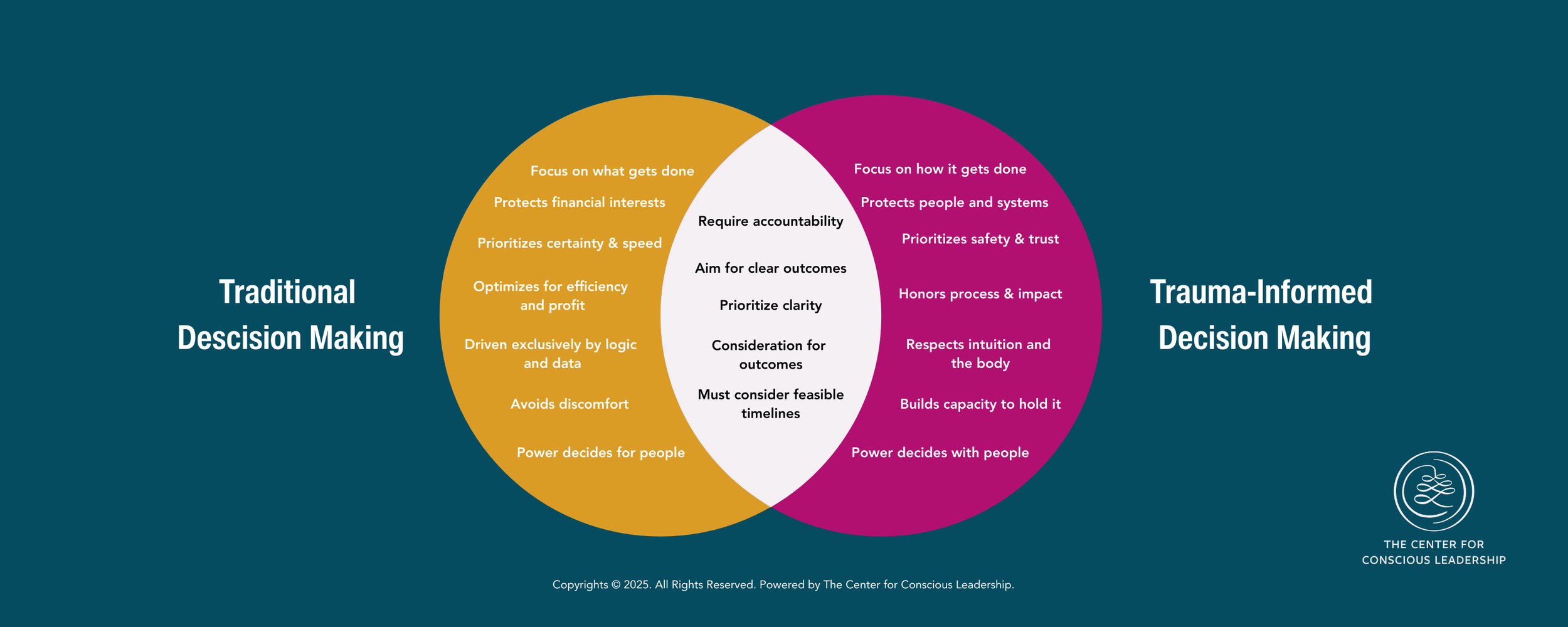
Traditional vs. Trauma-Informed Decision-Making
Both traditional and trauma-informed decision-making can be effective. But the question is: at what, and to what end?
The primary difference is in what they protect and what they cost.
Traditional decision-making protects timelines and outcomes.
Trauma-informed decision-making protects people and systems—and discovers that when you do, timelines and outcomes improve.
What Trauma-Informed Decision-Making Looks Like in Practice
If you can't regulate, you can't relate. If you can't relate, you can't lead.
Here are moves that make the invisible visible, translating the concepts behind Safety, Belonging, and Leadership into real-time trauma-informed decision making.
Safety Moves for Trauma-Informed Decision Making:
Settle the systems before you choose.
Practice the Conscious Pause: Scan yourself, make sense of your experience, and move forward intentionally.
Consider the Regulation Ripple Effect: Notice the relational field. Calibrate yourself, signal safety, sync with the room.
Create Conditions for Safety: Design for psychological safety. Clear timelines, roles, responsibilities, expectations, and processes help people to feel safe and valued.
Identify Protection Patterns: Name Protection Patterns, and False Forwards as they emerge. Understand what’s being protected and why. Create safety where you can.
Belonging Moves for Trauma-Informed Decision Making:
Honor the relational weight of every choice.
Choose Co-Creation: Co-create the how, not just the what. Invite collaboration into processes and products alike.
Name the Stakes: Acknowledge what’s at risk, who is taking a risk, who is shouldering more than others, and what hangs in the balance beyond the spreadsheets.
Say the Quiet Part Out Loud: Surface undiscussables and elephants in the room. Name it, create space for it, and ensure that it’s resolved so it doesn’t run the room.
Build Trust through Repair: History lives on in the room as culture. Repair what was broken, learn from it, and prevent future missteps where possible.
Agency Moves for Trauma-Informed Decision Making:
Protect voice, choice, and control.
Protect Choice: Even when the decision is made, people need voice in how it lands.
Close the loop: Tell people what happened, why, and what it means for them.
Run a CLEAR AAR: Don't just ask what happened—ask how it landed. Who was impacted? What needs repair?
Every decision teaches your team what's possible. These moves ensure the lesson is one worth learning.
The Conscious Leadership Invitation
One Acre Fund didn't slow down because the metrics weren’t important, or because the mission or vision changed. The organization adjusted course because the way you decide is the culture you create.
When you pause to check for wellbeing and nervous system states before moving forward, you're not being soft—you’re building the capacity for wise action.
When you include the people most affected in the decision, you're not slowing progress—you’re ensuring the decision will actually work for the people affected.
And when you adjust metrics to meet reality instead of forcing people to meet metrics that don't account for reality, you're not lowering standards—you're leading from values instead of fear.
This is rigorous work. The kind that builds cultures strong enough to withstand tremendous difficulty, uncertainty, and complexity.
The question isn't whether your next decision will be hard; it's whether you'll meet the moment in a way that builds trust, strengthens team capacity, and creates the culture and impact you desire intentionally.
At The Center for Conscious Leadership, we help leaders navigate the tension between urgency and humanity—so decisions build cultures, not just outcomes.
If you know that how you decide matters as much as what you decide, let’s talk.
→ Schedule a consultation or join our Trauma-Informed Leadership Program.
