

False Forwards: Why Your Smartest Strategies Might Be Your Biggest Blind Spots

How the “smartest” moves in leadership quietly sabotage trust, safety, and repair.
When Good Leadership Goes Wrong
Mara had everything you could want in an executive—she was decisive, measured, and effective.
When conflict erupted between two departments, she saw the dysfunction clearly: progress slowing, meetings devolving into blame, and collaboration grounding to a halt.
She acted swiftly, creating a cross-functional task force and implementing a clear new policy around decision-making and accountability to ensure alignment and forward momentum. Teams on both sides nodded, relieved to be given some guidance.
The issue seemed resolved.
In the following weeks, though, something shifted. Meetings were polite, but sterile. When Maya asked how things were going, her team used words like “fine,” or “smooth.”
Mara hadn’t made a bad decision—in fact, most see as normal corporate leadership.
Instead, she’d made a protective one. A False Forward.
The Hidden Cost of “Good Leadership”
Not all harm looks like dysfunction. Not all avoidance looks like fear.
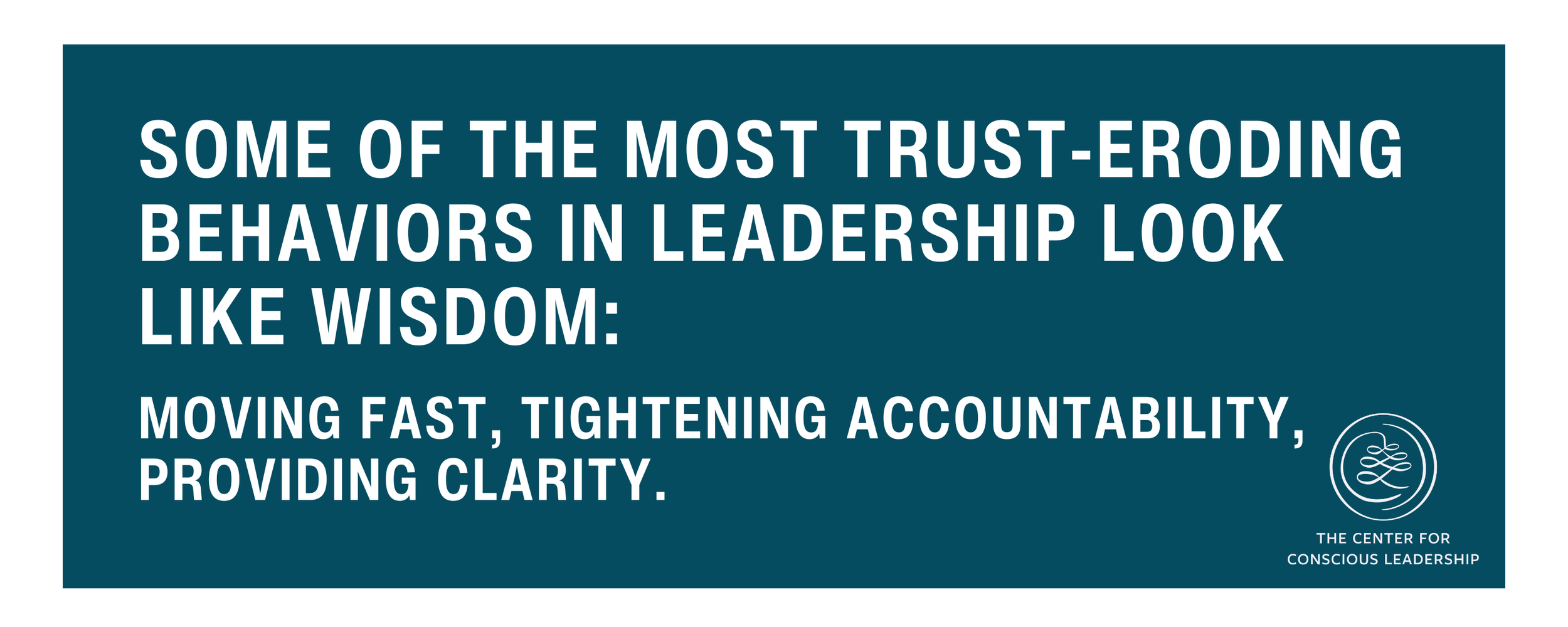
Some of the most trust-eroding behaviors in leadership look like wisdom: moving fast, tightening accountability, providing clarity. These are habits that we praise and reward, because they look like progress.
In reality, they’re often fear-based detours that quietly undermine trust and delay repair.
We call these False Forwards, the seductive strategies of leadership that give us a quick fix, but neglect larger, structural and relational flaws. They’re seductive because they appear to work: They calm our anxiety and make us look decisive. They allow us to apply a solution without spending much time to identify what’s really breaking.
And they’re dangerous because they work—until they don’t.
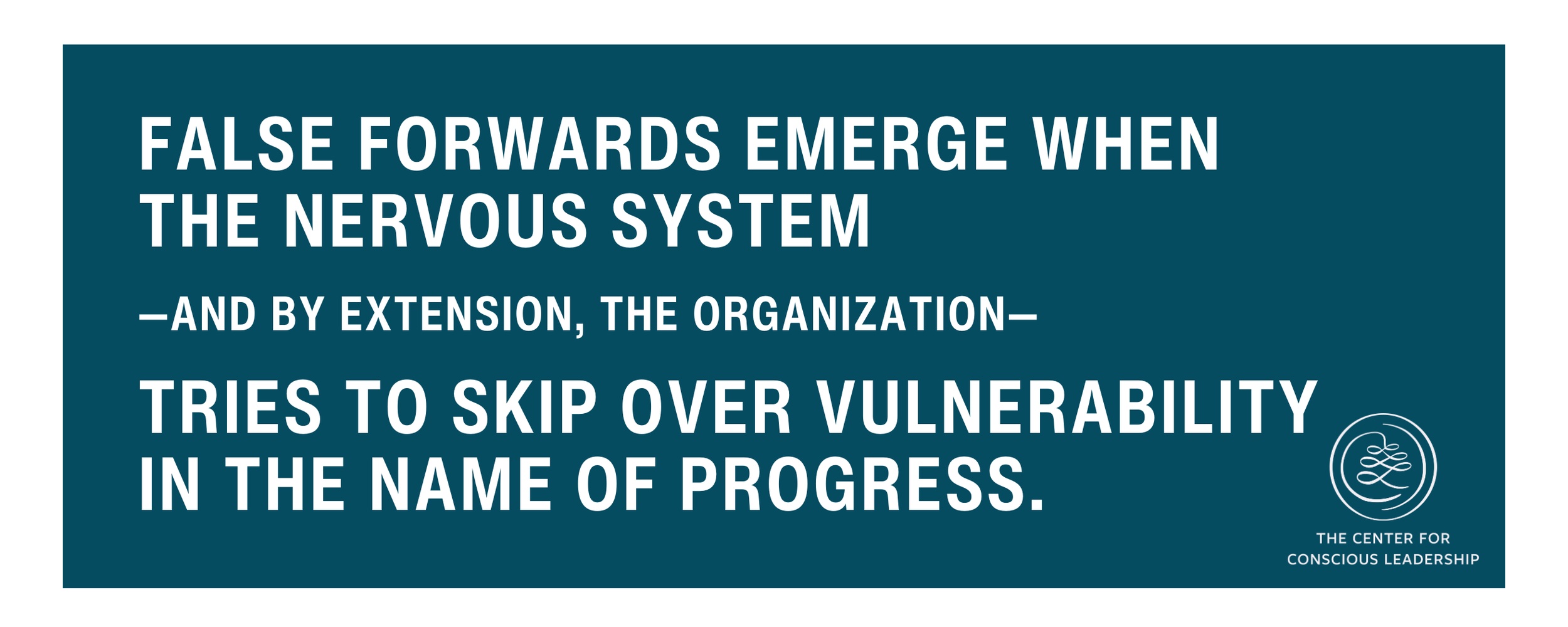
False Forwards emerge when the nervous system—and by extension, the organization—tries to skip over vulnerability in the name of progress. They are the leadership equivalent of a body bracing for impact.
In trauma-impacted and high-stress systems, False Forwards are especially dangerous, because they reinforce the very systems which conscious leaders are trying to heal.
The Pattern: Why Seductive Strategies Feel So Smart
False Forwards aren't moral failings. They're nervous system responses dressed up as strategy.
They emerge when leaders feel threatened—not physically, but psychologically or relationally. When our sense of safety, control, or dignity feels at risk, our nervous systems reach for protection. In leadership, that protection looks like:
Creating urgency to stay competitive and relevant
Pushing clarity rather than embracing uncertainty
Controlling the narrative to avoid ambiguity
Limiting conflict to keep the peace
Every one of these moves feels intelligent. They feel like leadership. They’re modeled by our mentors, rewarded by our corporate cultures, and reinforced by systems that prize productivity over connection.
But these are not acts of trust, they are acts of fear—fear of loss, fear of exposure, fear of losing control.
What makes them so appealing is that they look like progress:
Urgency looks like momentum.
Clarity looks like competence.
Controlled narratives look like alignment.
Lack of conflict looks like effortless collaboration.
But these False Forwards mask reality and avoid the deeper threats at play.
The Five Threats Beneath Every False Forward
Based on David Rock’s SCARF Model, there are five main “domains” where leaders perceive potential threats and rewards: Status, Certainty, Autonomy, Relatedness, and Fairness. Every False Forward is a response to a perceived threat in one of these domains.
Ironically, the strategies leaders use to protect themselves in these domains often damage them further. Those who move to protect their status with a False Forward end up eroding it—protecting your image as a leader often costs you your actual effectiveness.
Most leaders default to 2-3 of these under pressure. Which are yours?
1. STATUS
In high-performance cultures, worth is measured by output and visibility. Leaders internalize the need to prove their value constantly. When advice feels like criticism, when they're excluded from decisions, or when their contributions go unrecognized, status feels threatened. To protect it, they overwork, hoard information, perfect everything, and refuse help—all to signal: I'm indispensable.
What leaders say:
"If I show them I can handle this alone, they'll finally see I'm competent."
"If I don't step in and fix this, they'll think I'm not doing my job."
"The more I deliver, the more valuable I am."
Seductive Strategies:
More = More: Perform productivity to prove value.
Strength as Identity: Overfunction to maintain the image of power and reliability.
Hoarding Information: If I’m the one who knows, I’m valuable and safe.
Perfectionism: I can’t be criticized if my work is flawless.
Overworking: If I demonstrate indispensability, they’ll value me.
The Cost: These strategies were meant to prove worth and reassert status—but they signal insecurity and isolation. Teams stop collaborating because the leader hoards knowledge. Innovation stalls because nothing is ever good enough. The leader wanted to look strong and valuable. Instead, they look controlling, exhausted, and impossible to work with.
2. CERTAINTY
When clarity disappears, leaders reach for control. They demand data, document everything, micromanage execution, and talk over uncertainty with projected confidence. They need to make sense of chaos—not by sitting in it, but by forcing it into frameworks, metrics, and narratives they can control.
What leaders say:
"What does the data say? Data is data…we can always trust the data.”
"Let me write it down. If I get it on paper, it’ll finally make sense."
"We need to get aligned on this."
Seductive Strategies:
Control the Narrative: Offer the illusion of certainty when truth is messy.
Certainty over Curiosity: Project confidence while shutting down dialogue.
Documentation: If I write it down, I’ll have some control over the outcome.
Data over Intuition: If I can quantify it, I can control it.
Micromanagement: I can’t control the outcome, but I can control you.
The Cost: These tactics were meant to create clarity—but they broadcast fear. Teams learn that ambiguity isn't safe to name. Questions get shut down. The leader wanted to appear confident and in control. Instead, they appear rigid, afraid of what they don't know, and unable to navigate complexity.
3. AUTONOMY
When things feel out of control, leaders overcompensate by exerting control wherever they can—timelines, decisions, other people's work. They create urgency, enforce policies, micromanage, gatekeep, and refuse help. Every move is designed to restore the feeling: I still have agency here.
What leaders say:
"We need to move on this now."
"Let's put a policy in place so this doesn't happen again."
"I have no idea if my job is safe, so I’m going to micro-manage to try to exert more control, and ensure my job is safe.”
Seductive Strategies:
Creating urgency: Force movement to avoid feeling powerless.
Policy over conversation: Avoid nuance by enforcing structure.
Micromanagement: Exert unnecessary control over how others do things.
Gatekeeping Decisions: If everything goes through me, I have the illusion of control.
Hyper-Independence: Refuse help to maintain independence and self-sufficiency.
The Cost: These moves were meant to restore control—but they create rigidity and resentment. Teams stop taking initiative because everything must go through the leader. Collaboration collapses. The leader wanted autonomy and control. Instead, they've created a culture of dependence, where nothing moves without them—and they're drowning.
4. RELATEDNESS
Leaders who've experienced betrayal, rupture, or chronic stress often avoid vulnerability. They keep relationships pleasant but not real—limiting conflict, managing perceptions, forcing positivity, people-pleasing their way through tension. Proximity is maintained. Honesty is not.
What leaders say:
"Let's keep things positive and focus on the work."
"They can deal with their interpersonal qualms elsewhere, this is business."
"If I get this email wording just right, I’ll be safe.”
Seductive Strategies:
Limiting open Conflict: Maintains proximity but avoids honesty.
Bypassing Tension: Moves past discomfort to preserve harmony.
Perception Management: Manages image to prevent exposure.
Forced Positivity: If we only talk about the good stuff, there will only be good stuff.
People-Pleasing: I can stay safe if I avoid conflict.
The Cost: These strategies were meant to preserve connection—but they prevent intimacy. No one knows the real leader. Trust erodes quietly—not through conflict, but through emotional distance. The leader wanted closeness and safety. Instead, they've created relationships where everyone performs connection without experiencing it.
5. FAIRNESS
In environments marked by broken trust—layoffs, inequity, organizational harm—leaders default to procedural protection. They document everything, follow protocol rigidly, enforce accountability systems, and defend their decisions with evidence. Paper trails replace trust trails. Policy creates the safety that relationships no longer provide.
What leaders say:
"If I document everything, I'll be protected if this goes wrong."
"If I follow protocol exactly, no one can blame me."
"If I have it in writing, I have proof I did the right thing."
Seductive Strategies:
Policy over conversation: Create distance from unpredictable human behavior.
Documentation: Build paper trails instead of trust trails.
Skipping the pause: Avoid the vulnerability of repair.
Excess Accountability: If I can point to who did it, it’ll keep me safe, it’s only fair.
Defensiveness: If I can prove I did nothing wrong, I’ll be okay.
The Cost: These moves were meant to create safety and fairness—but they create brittleness and fear. The system becomes technically compliant but emotionally barren. Repair becomes impossible because vulnerability is too risky. The leader wanted protection. Instead, they've built a system where no one feels safe enough to be honest, admit mistakes, or ask for help.
The Cost of Performative Leadership
False Forwards are leadership on autopilot—nervous system responses that seek to alleviate discomfort masquerading as sound strategy.
In Mara’s story, she solved the immediate issue while avoiding the discomfort of sitting with her team in the midst of conflict to understand the rupture at the core. Her choice forced a structure that performed collaboration and effective decision-making without the practices that actually constitute either.
Her choice protected her from the vulnerability of navigating difficult conversations, embracing conflict, and potentially receiving negative feedback about her leadership.
But it also cost her the teams’ ability to collaborate authentically, speak candidly, and build a relationship built on trust that repair is possible.
Over time, Protection Patterns prevent the very thing individuals and teams need the most: connection. In trauma-impacted systems—those marked by chronic stress, iniquity, and rupture—connection is the work. Fear-based leadership strategies don’t just avoid the issue in the moment, they prevent healing for the long haul.
One leader we worked with described this perfectly: “functionally polite but emotionally absent.”
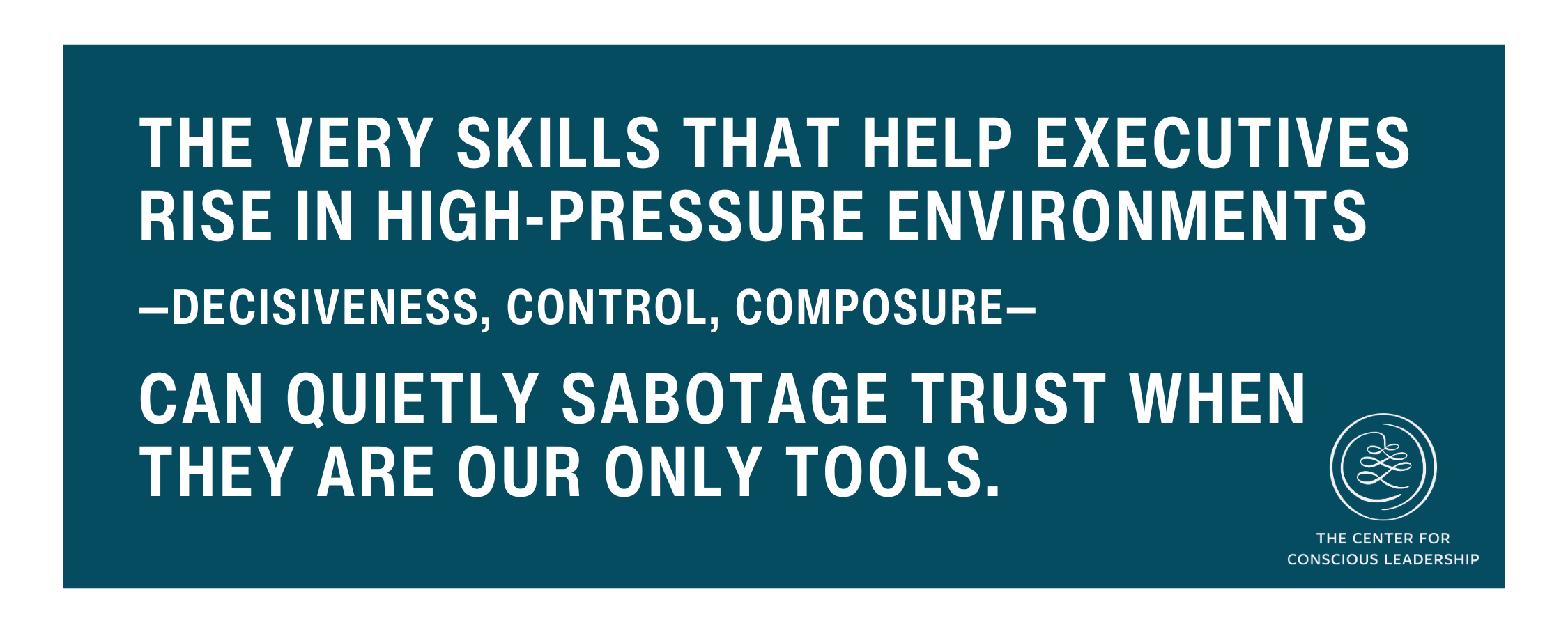
The very skills that help executives rise in high-pressure environments—decisiveness, control, composure—can quietly sabotage trust when they are our only tools.
From False Forwards to Real Repair
Trauma-informed leadership doesn’t mean abandoning clarity, accountability, or direction. It means leading with nervous system awareness, and recognizing when we’re moving from fear instead of trust.
Here’s how to begin shifting:
1. Name Your Go-To False Forward
You can’t interrupt a pattern you don’t recognize. Here’s what to do to create intentional choice:
Review the list of False Forwards and identify your top 3
Notice when you reach for them (What situations? What emotions?)
Ask: Is this strategy serving connection—or protecting me from discomfort?
2. Diagnose the Fear Beneath the Move
False Forwards feel rational in the moment because they're solving for an emotional need, not a strategic one. Until you name the fear, you'll keep reaching for the same protective move. Before acting, pause and name what you’re actually protecting:
What am I protecting right now? (Status? Control? Image? Safety?)
What am I avoiding? (Conflict? Uncertainty? Vulnerability? Exposure?)
Is this threat real—or is my nervous system bracing for impact?
3. Choose Connection Over Control
True leadership means creating the conditions where answers can emerge together, and answers emerge when connection and trust exist. Before defaulting to structural solutions, ask:
Whose perspective would deepen this decision?
What conversation am I avoiding?
What becomes possible if I stay in relationship instead of defaulting to policy?
4. Slow the System Down
When we're overwhelmed and struggling, urgent action feels like progress. But true progress happens at the pace of humanity, which requires time. When urgency and anxiety spike:
Breathe before announcing the decision
Name the pressure you're feeling: "I feel urgency to resolve this right now. Let me check if that urgency is real and necessary or if I'm just uncomfortable."
5. Redefine Strong Leadership
Strength is not the absence of emotion or difficulty, it’s the capacity to stay relational, regulated, and productive in the midst of it. Policy can't create psychological safety; only humans can. Rather than being unshakeable, be reachable:
Name what you're feeling: "I'm noticing I feel defensive right now."
Acknowledge impact: "I realize my urgency yesterday made it hard for you to think clearly."
Invite dialogue: "What do you need from me that I'm not giving?"
What Mara Did Next: Humanizing Leadership
Six months later, Mara stood in front of her team and said something she'd never said before:
"I got it wrong."
She named what she'd done: implementing structures to prevent further conflict instead of sitting in and resolving conflict that already existed. She acknowledged the cost: trust eroded, collaboration stalled, people learned to perform harmony instead of building it.
Then she asked: "What do you need from me now?"
The conversation that followed was uncomfortable. People named what had broken. They shared what they'd been holding back. They surfaced tensions that had been festering for months. Mara listened without defending, without fixing, and without moving to immediate action.
It didn't resolve everything. But it reopened the door to repair.
Her team didn't need a perfect leader. They needed a present, regulated, and conscious one.
Reflection for Leaders
Before your next decisive move, ask yourself:
Am I leading from protection or connection?
Is this a move toward trust—or a detour around it?
What might become possible if I slowed down enough to stay human here?
False Forwards promise safety. Connection actually creates it.
The shift from fear to trust, and from protection to connection, is the work for conscious leaders in transforming the workplace from one that harms into one that heals.
At The Center for Conscious Leadership, we work with leaders who want to move from False Forwards to real repair—leaders ready to build trust, not just manage it.
If you're navigating the tension between decisiveness and humanity, we can help.
→ Schedule a consultation or join our Trauma-Informed Leadership cohort.
