

Power Mapping for Influence | The Hidden Architecture of Strategic Influence

How conscious leaders decode organizational power to lead change with integrity.
Why Power Mapping Matters
You can’t change a system without understanding how it moves.
Every organization is an ecosystem of influence—structural, relational, and emotional/energetic. Titles and org charts tell part of the story, but the real dynamics of power live in trust, history, and human emotion.
Leaders often assume that authority equals influence. But in reality, influence is built through relationships. The people who quietly shape decisions, ease tensions, or carry the organization’s emotional memory often hold far more sway than those whose names sit at the top of the org chart.
When leaders don’t take the time to map these dynamics, they end up leading by guesswork. Leadership without awareness either burns bridges or burns you out. Power Mapping helps leaders bridge the divide and embrace their part of the system, rather than trying to lead from beyond it.
Most change efforts fail not because the vision was wrong, but because leaders never paused to understand the terrain. Power Mapping is the missing step between intention and impact. It helps you get a feel for the playing field before you make a first move, and often is the difference between a successful transformation and lingering resentment when large-scale changes fall through.
What Is Power Mapping?
Power Mapping is a conscious leadership tool that helps you visualize and analyze influence across your organization. When you understand the ways trust and influence operate in your teams, you can free your change efforts from blind spots, assumptions, and unintended harm. Like a school of fish following the current, you can create (and receive) influence by noticing where people are pulled.
A Power Map charts three dimensions of influence:
Structural Power – titles, roles, decision rights, budgets, and reporting lines.
Relational Power – who people listen to, who brokers trust, who connects silos, and who gets consulted unofficially.
Emotional/Energetic Power– who holds the organization’s collective emotions—fear, admiration, grief, hope, or trauma.
When you see all three layers together, you begin to understand not just who makes big decisions, but who holds trust, who carries emotional weight, and who supports the team in times of hardship and uncertainty.
Conscious leaders want to bring humanity to their workplaces and connect with their teams. Power Mapping doesn’t just improve execution—it transforms your capacity to lead effectively and seamlessly in complex systems, and ensure humanity stays king. If teams naturally gravitate towards one person, there is a reason. Resist the power struggle and use what you know to create the changes you need.
How to Use It: The Three Layers of Mapping
A good Power Map helps you see beyond politics into patterns. Here’s how to approach it.
1. Structural Power: Who Controls What
Start with the obvious: who holds authority, access, or control over resources, decisions, and information. This is the easiest layer to chart—and the least sufficient on its own. To determine who has structural power, ask:
Who approves budgets and staffing decisions?
Whose metrics determine success?
Which processes shape what gets prioritized or ignored?
This gives you the architecture of power, but not the energy that moves through it.
2. Relational Power: Who Influences Whom
Next, map the informal webs—those lines of credibility, mentorship, and trust that make or break momentum. Picking out the most influential individuals means asking:
Who do people seek out for advice?
Who builds bridges across silos or teams?
Who quietly shapes opinions before meetings ever start?
Whose voice holds disproportionate weight, potentially stalling initiatives?
Relational power is where most changes succeed or fail. If you recognize whose voice is essential to the co-creation process, or whose “blessing” seems necessary for progress, you’ll know who can help take initiative and ensure success. When you know who people actually listen to, you stop trying to push change from the top down and start designing it through the system.
3. Emotional/Energetic Power: Who Holds Psychological Weight
Finally, layer in the emotion. Who evokes fear, loyalty, grief, or admiration? Who represents unresolved history—past harm or past healing? This step may take more time, as these connections are complex (like any human system). To map emotional power, ask:
Who holds the institutional memory of a painful merger or a broken promise?
Who carries respect because they protected others in hard times?
Who still triggers anxiety when they walk into the room?
Whose nervous system deeply impacts the tone?
This layer reveals the nervous system of the organization. Change that ignores emotional gravity will always face unseen resistance.
After you understand how these three layers of power operate in your organization, you’ll be able to more effectively implement changes and accurately take the temperature of your team.
People don’t automatically obey authority for the sake of it. Old systems of leadership reacted to this with punishment, fear, and pressure. Conscious leaders know systems built on fear burn up and burn people out—and they’ve found another way. When you work within established trust networks, you cut through the middle and go straight to the source.
In trauma-informed systems, trust is power.
From Insight to Action
Ethical influence starts here—acknowledging that behind every person resistant to change is often acting from an unhealed fear or unmet need. When you lead with curiosity instead of coercion, you encourage dialogue, input, and collaboration. You can discover what someone needs to embrace change, and help meet that need or remove that obstacle.
Mapping power is only the first step. The goal is to translate insight into ethical, effective action.
Once your map is clear, identify four key roles in your change effort:
Allies – Those who will naturally support or amplify your work.
Blockers – Those who may resist, consciously or unconsciously.
Bridges – Those who can connect you to influence or soften resistance.
Bystanders – Those who observe the process and influence others by example.
Then ask three critical questions for each:
What does this person need to get engaged at work?
What’s their stake in or fear of the current system?
How can I engage them with dignity, not just strategy?
It’s important to note that allies, blockers, bridges, and bystanders can be more than individual people—they can be teams, departments, and even outside agencies, stakeholders, and the media. All of these things are involved in Power Mapping, and they all shape how influence moves in your organization.
True power isn’t about pushing harder, it’s about lowering the activation in the nervous system so that change can move without triggering defensive responses. It’s about co-creating via collaboration so that nothing is being done to anyone, rather, it is being done with them. Conscious leaders are trauma-aware leaders, making choices thoughtfully and taking their team’s nervous systems into account before passing down instruction.
Trauma-Informed Application
Power is never neutral.
It shapes and is shaped by history—by who has been heard and prioritized versus who has been ignored and silenced. A trauma-informed approach to Power Mapping recognizes that we feel most empowered, liberated, and motivated when we choose action together rather than submitting to what is done to us.
Trauma-informed leadership might mean an initial slowing down. You prioritize repair over speed. You engage blockers not as obstacles, but as people protecting something that once felt unsafe to lose. Every individual brings their own nervous system and their own experiences, and ignoring their contexts helps no one. A trauma-informed leader understands that influence without integrity creates backlash. That manipulation may win compliance, but it erodes trust.
Ethical influence = relational integrity + systemic awareness.
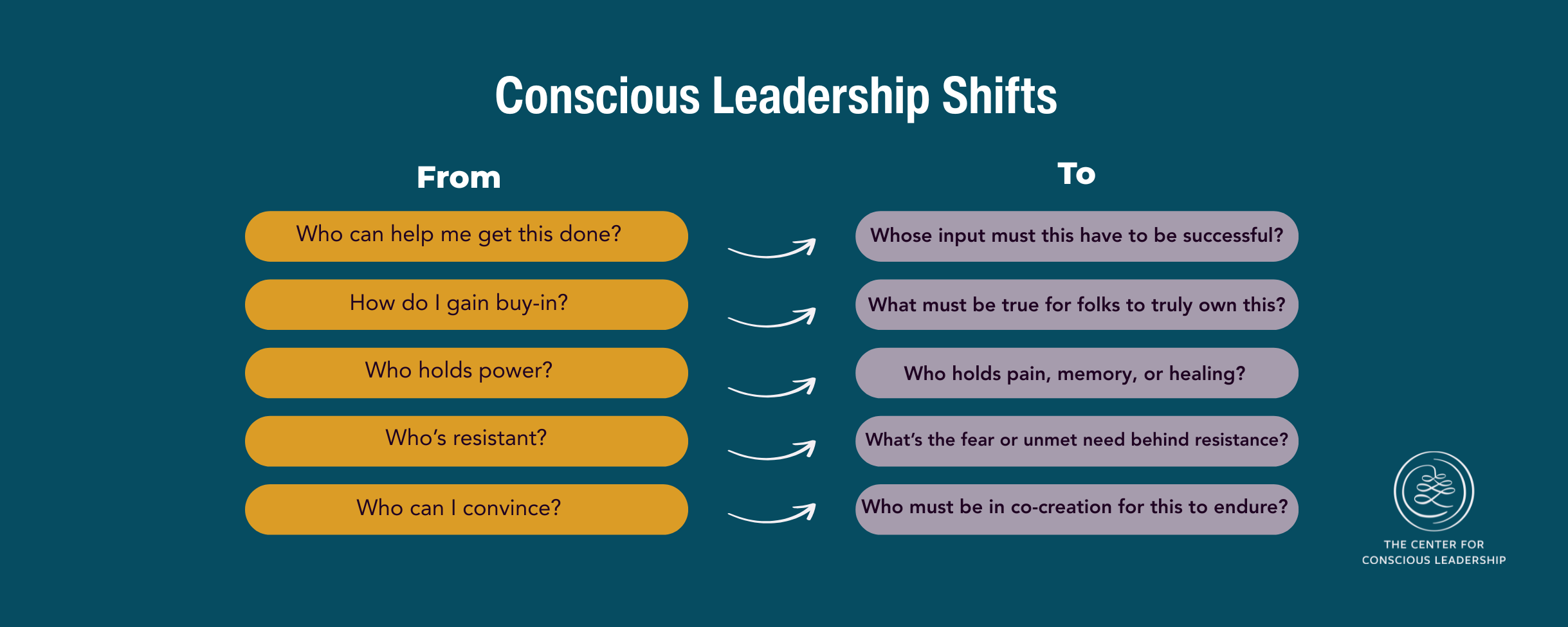
When leaders use Power Mapping consciously, they shift from “How do I get what I want?” to “How do we move this system toward wholeness?” Traditional leaders use their power over others to force changes, regardless of the status quo it creates. Conscious leaders use their power with others to create self-sustaining, self-motivating, self-correcting systems based on what aligns within the organization itself. Not only is it less effort to find the flow and move with it, it is much more effective, because it is already in motion.
Map Before You Move
Every leader has a vision for change. But before you act, pause and map.
Ask yourself:
What change am I trying to lead?
Have I mapped the formal, informal, and emotional layers of power around it
Who holds the key to unlocking movement—and how will I engage them with care?
Influence without inclusion breeds harm. Awareness without action breeds frustration. Power Mapping helps leaders bridge both—using their systemic awareness and their relational integrity to find a clear path forward.
When done well, Power Mapping becomes a leadership practice of liberation. It helps you see the unseen, respect the human, and move the system with wisdom.
Conscious Leadership Shifts
These shifts redefine influence as a force for collaboration rather than control.
When leaders move with relational intelligence, systems begin to self-correct. Power becomes distributed, not hoarded. Trust becomes renewable. And change—real, human change—becomes possible. Ethical influence is built on relational integrity and systemic awareness. When you understand the systems at play, and you honor the relationships that your organization is built upon, you can make the changes you wish to see.
We often dismiss these relationships of power as “office politics.” But consider how politics can and do shape your life, how they determine who you report to, who you ask for help, and how or why you are denied or granted assistance. Don’t be too quick to dismiss the “politics” at play—they will impact your teams regardless. Power Mapping isn’t about politics, it’s about presence.
It asks leaders to slow down long enough to see the living system they are trying to move—and to lead not with pressure, but with attunement. Because when you map with integrity, you stop playing the power game and start healing the power grid. And that’s how insight becomes action, and action becomes transformation.
If you’re ready to understand your teams on a deeper level and start influencing (and being influenced) by these systems at play, check us out at the Center for Conscious Leadership. We’re running a Trauma-Informed Leadership course that teaches you concepts like Power Mapping and how to implement them in humane, effective ways. Or, book a call with us—we match coaches with leaders and have a 100% satisfaction rate (yes, really).
